
Epoxy floors are known for durability, chemical resistance, and long service life, which is why they are widely used in warehouses, manufacturing plants, maintenance areas, commercial kitchens, and other demanding facilities.
But when an epoxy floor begins peeling, bubbling, flaking, or separating from the concrete, something has gone wrong beneath the surface.
If you are asking, “Why is my epoxy floor peeling?”, the answer is usually not that epoxy itself is unreliable. Most coating failure can be traced back to surface preparation, moisture, application conditions, coating compatibility, or the demands placed on the floor after installation.
Understanding what caused the failure is important because simply applying another coat over the damaged area usually does not solve the problem. The underlying issue has to be corrected first.
Here are the most common reasons epoxy floors fail and what facility owners should know before repairing or recoating them.
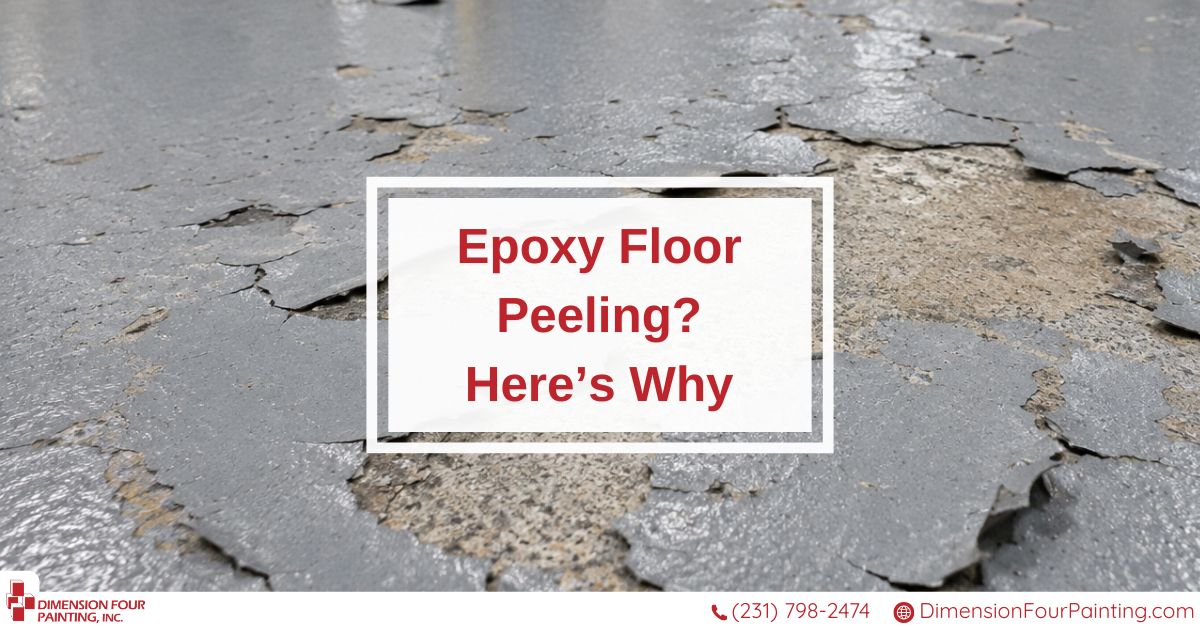
What Does Epoxy Floor Failure Look Like?
Epoxy coating failure does not always appear the same way. Some floors begin peeling around edges or high-traffic areas, while others develop bubbles, cracks, or large sections that detach from the concrete.
Common warning signs include:
- Peeling or flaking coating
- Bubbles or blisters beneath the surface
- Areas where the coating lifts from the concrete
- Cracking or chipping under traffic
- Uneven adhesion between different sections
- Discoloration or cloudy areas
- Exposed concrete appearing through worn coating
The location and appearance of the damage can provide clues about what caused it. Peeling across large areas may indicate poor adhesion or moisture problems, while isolated wear near equipment or traffic lanes may point to mechanical damage or an incorrect coating system.
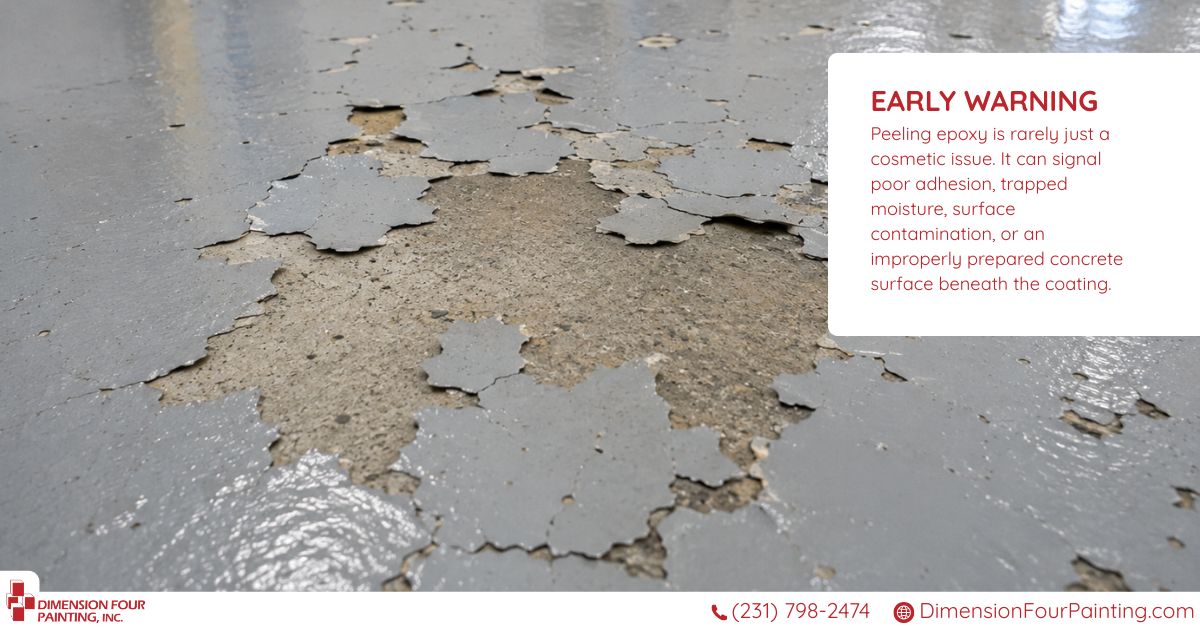
1. Poor Surface Preparation
Poor preparation is one of the most common causes of epoxy coating failure.
Concrete may look clean while still containing dust, oil, grease, sealers, curing compounds, old coatings, or other contaminants that interfere with adhesion. Epoxy needs direct contact with a properly prepared surface to bond correctly.
Simply sweeping or washing the floor is often not enough. Professional preparation may involve degreasing, diamond grinding, shot blasting, crack repair, and mechanical profiling to create the right texture for the coating.
If the concrete is too smooth, contaminated, or covered with unstable material, the epoxy may bond only to the surface layer instead of the concrete itself. Eventually, traffic and normal building movement can cause the coating to separate.
This is why professional industrial floor coating services place so much emphasis on preparation. The visible coating is only as strong as the surface underneath it.
2. Moisture Coming Through the Concrete
Moisture is another major cause of epoxy floor peeling.
Concrete is porous, and moisture can migrate upward through a slab from the ground below. If that moisture becomes trapped beneath an impermeable coating, pressure can build between the concrete and epoxy.
The result may be bubbling, blistering, discoloration, or complete loss of adhesion.
Moisture problems are particularly common in older buildings, slabs without effective vapor barriers, below-grade areas, and facilities with frequent washdowns or high humidity.
A floor can appear completely dry on the surface while still transmitting moisture from below.
That is why professional installers may perform moisture testing before selecting a floor coating system. If moisture levels are too high, additional preparation, moisture-control primers, or a different coating approach may be necessary.
Applying new epoxy without identifying the moisture source can cause the repaired floor to fail again.
3. Concrete Was Too Smooth
Epoxy needs texture to grip the concrete.
New or polished concrete can sometimes be too smooth for proper adhesion. Even older concrete may have a dense surface that prevents coatings from bonding effectively.
Mechanical surface preparation creates what is called a concrete surface profile, or CSP. The goal is to open the surface and create enough texture for the primer and epoxy system to mechanically bond with the slab.
Different floor systems require different levels of profiling. Heavy-build industrial epoxy, for example, may require more aggressive preparation than a thinner coating.
When this step is skipped, the coating may initially look perfect but begin peeling once forklifts, carts, machinery, or regular foot traffic place stress on the surface.
4. Oil, Grease, or Chemical Contamination
Industrial and commercial floors are frequently exposed to materials that make coating adhesion difficult.
Motor oil, hydraulic fluid, cutting lubricants, food grease, cleaning chemicals, silicone, and other contaminants can soak into concrete. Even after the surface is cleaned, residue may remain inside the pores.
If epoxy is applied over contaminated concrete, adhesion may be weak in those areas.
This often produces localized coating failure around machinery, maintenance bays, production equipment, loading areas, or anywhere spills commonly occur.
Proper degreasing and contamination testing are therefore important before installation. In heavily contaminated areas, multiple cleaning cycles or more aggressive surface removal may be needed before the floor can accept a new coating.
5. The Wrong Primer Was Used or Primer Was Skipped
Primer helps create a strong bond between the concrete substrate and the epoxy system.
Some floor coating systems can technically be applied without primer, but that does not mean primer should always be skipped. The right primer can help penetrate porous concrete, improve adhesion, reduce outgassing, and address specific substrate conditions.
Problems occur when installers use an incompatible primer, apply it incorrectly, or eliminate the step to reduce installation time.
Without a proper bond coat, the epoxy may have difficulty adhering evenly to the floor. This can result in peeling, pinholes, bubbles, and inconsistent performance.
A professional coating system should be selected as a complete system, not as a collection of unrelated products.
6. Incorrect Mixing or Application
Epoxy is usually a two-component product consisting of resin and hardener. These components must be mixed at the correct ratio and applied within a specific working period.
Incorrect mixing can prevent the coating from curing properly.
Too much or too little hardener, incomplete mixing, or exceeding the product’s pot life can result in soft areas, sticky surfaces, uneven curing, or weak adhesion.
Application thickness also matters. Applying epoxy too thin may reduce durability, while applying it too thick can create curing problems depending on the product.
Professional installers follow manufacturer specifications for mixing ratios, temperature, application thickness, cure time, and recoating windows. These details may seem small, but they can make the difference between a floor that lasts and one that fails prematurely.
7. Temperature and Humidity Were Outside the Recommended Range
Environmental conditions affect how coatings cure.
Most epoxy products have recommended temperature and humidity ranges for both the substrate and surrounding air. If the concrete is too cold, too hot, or exposed to excessive humidity, curing can become unpredictable.
Condensation is another concern. A slab may develop a thin layer of moisture when its temperature approaches the dew point. This moisture may be difficult to see but can interfere with adhesion.
In industrial facilities, conditions can also vary dramatically between areas. Loading docks, exterior-adjacent spaces, refrigerated areas, and production zones may all experience different temperatures.
Professional installers monitor these conditions before and during application rather than assuming the environment is suitable.
8. The Floor Was Put Back Into Service Too Soon
Epoxy needs time to cure before it reaches full strength.
A coating may feel dry to the touch while still being too soft for forklift traffic, heavy equipment, chemical exposure, or aggressive cleaning.
Returning the floor to service too soon can damage the coating before it has fully developed its intended mechanical properties.
This may lead to tire marks, impressions, scratches, delamination, or premature wear.
Facilities should follow the manufacturer’s cure schedule carefully. Professional installers also plan projects around operational requirements so enough cure time can be built into the schedule without creating unnecessary downtime.
9. The Coating System Was Not Designed for the Environment
Not every epoxy system performs the same way.
A light-duty coating that works well in a storage room may not survive in a manufacturing plant where forklifts, chemicals, heat, abrasion, and constant traffic are present.
Facilities sometimes experience coating failure because the product itself was not matched to the demands of the environment.
Considerations may include:
| Facility Condition | Coating Requirement |
| Forklift and heavy cart traffic | High abrasion and impact resistance |
| Oils or industrial chemicals | Chemical-resistant coating system |
| Wet production areas | Slip resistance and moisture tolerance |
| Frequent cleaning | Washable, chemical-resistant topcoat |
| UV exposure | UV-stable topcoat |
| Heavy manufacturing | High-build industrial coating system |
| Food or healthcare environments | Cleanable, seamless finish |
Choosing the correct system upfront is often far less expensive than repeatedly repairing a coating that was never designed for the application.
10. Heavy Wear and Mechanical Damage
Sometimes the epoxy was installed correctly but has simply reached the limits of what it can handle.
Forklifts, steel wheels, dropped tools, pallets, machinery, abrasive debris, and constant traffic place significant stress on industrial floors.
Over time, scratches and chips can expose the coating system to additional damage. Once an edge begins lifting, traffic can progressively break away more material.
This type of failure often appears in predictable locations such as turning areas, loading zones, entrances, production lines, and around heavy equipment.
Regular inspection and small repairs can prevent isolated damage from becoming a larger flooring problem.
Can You Just Paint Over Peeling Epoxy?
Usually, no.
Applying new epoxy directly over failing material may temporarily hide the damage, but the new coating will only be as stable as the surface underneath it. If the existing epoxy is already separating from the concrete, the new layer may eventually come off with it.
A proper repair begins by determining why the original coating failed.
Loose material should be removed, the concrete should be evaluated, contaminants or moisture issues should be addressed, and the surface should be properly prepared before recoating.
This may involve repairing only isolated sections or removing larger portions of the existing system depending on the extent of the failure.
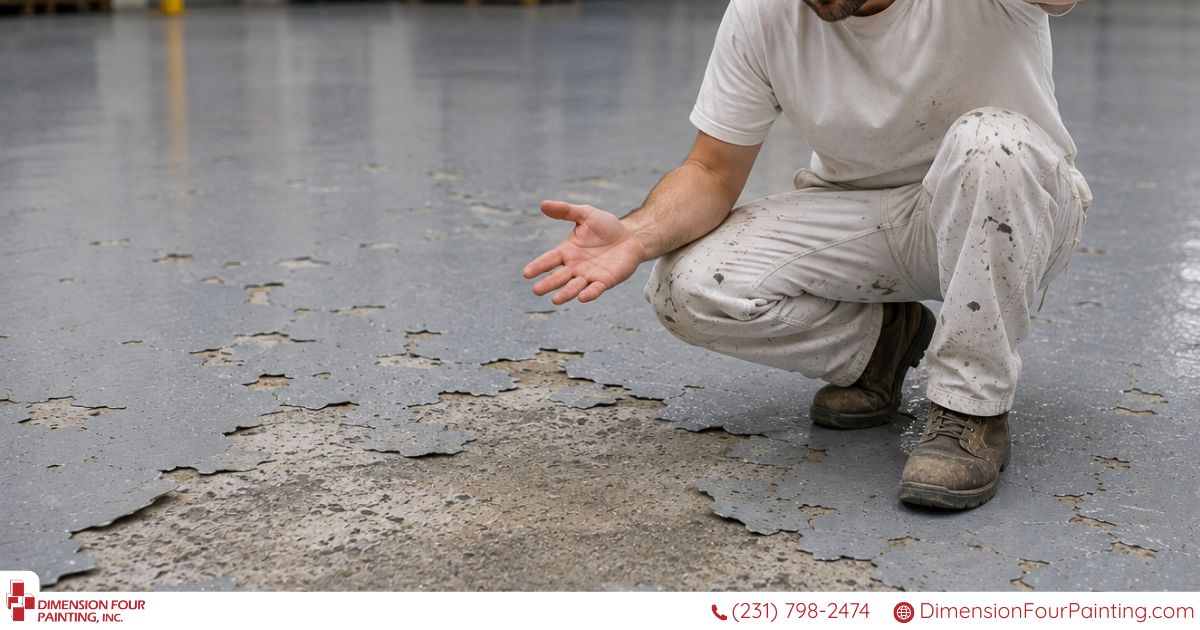
When Can an Epoxy Floor Be Repaired?
Not every damaged floor requires complete removal.
Small areas of impact damage, isolated peeling, or localized wear can sometimes be repaired if the surrounding coating remains strongly bonded.
Larger failures require more investigation. When extensive sections are peeling, moisture is present beneath the floor, or adhesion problems appear throughout the facility, patching individual areas may only delay a larger repair.
A commercial floor coating contractor can perform adhesion checks and inspect the underlying concrete before recommending the most practical approach.
The objective should be to solve the cause of the coating failure, not simply cover the symptoms.
The Real Cost of Epoxy Coating Failure
A failing epoxy floor creates more than an appearance problem.
Loose coating can make cleaning harder, expose concrete to chemicals and moisture, create uneven walking surfaces, and interfere with facility maintenance. In industrial environments, damaged floors may also complicate traffic markings, sanitation procedures, and equipment movement.
Repeated patching adds labor and materials while requiring areas to be taken out of service again and again.
A properly installed industrial floor coating generally costs more upfront than a quick coating job because preparation and installation take time. But those steps are what help prevent premature failure and reduce the need for repeated repairs.
Doing the floor correctly once is usually far more economical than recoating the same surface every few years.
How Professional Installation Helps Prevent Peeling
A reliable epoxy floor system begins with understanding the concrete before choosing the coating.
Professional installation typically includes:
- Inspecting the existing slab and coating
- Checking for moisture and contamination
- Repairing cracks and damaged concrete
- Grinding or shot blasting to create the correct profile
- Selecting compatible primers and coating systems
- Monitoring temperature and application conditions
- Applying coatings at the specified thickness
- Allowing adequate cure time before reopening the area
Each step contributes to adhesion and long-term performance.
Skipping even one can shorten the life of the entire system.

Fix the Cause Before Recoating the Floor
If you are wondering why your epoxy floor is peeling, the failure is often a symptom of something happening underneath the coating.
Poor surface preparation, moisture, contamination, incorrect application, environmental conditions, and mismatched coating systems are among the most common causes of coating failure. Simply covering damaged epoxy with another layer rarely provides a lasting solution.
The first step should always be identifying why the coating failed and correcting that condition before installing anything new.
Dimension Four Painting provides professional industrial floor coating services throughout West Michigan. We evaluate existing floors, prepare concrete properly, and install coating systems designed around the actual demands of your facility.
Whether you are dealing with isolated peeling or widespread coating failure, we can help determine the right approach before you invest in another floor system.
Ready to fix a failing industrial floor?
📞 Call 231-798-2474 today to discuss your project, or request your free, no-obligation industrial floor coating estimate online.
Let’s solve the problem underneath the coating and build a floor designed to perform for the long haul.